
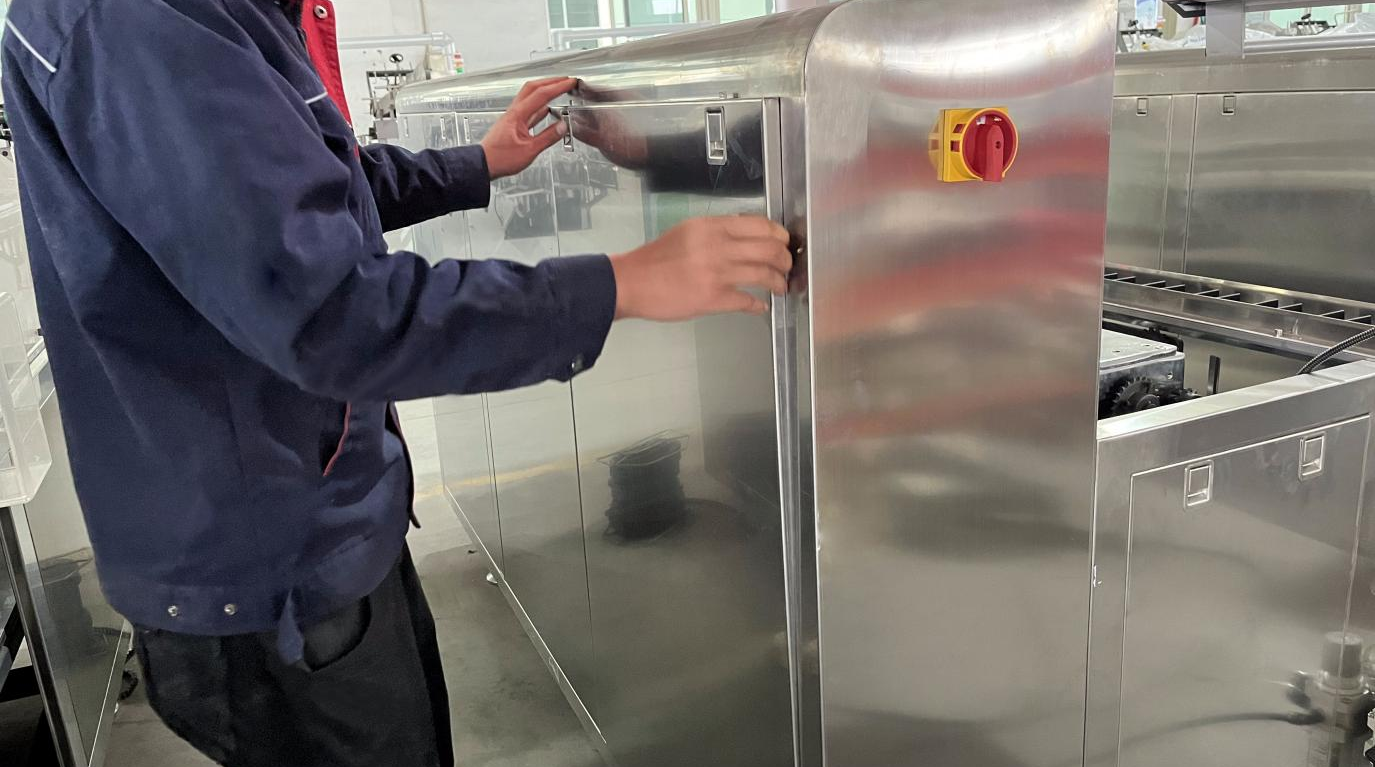
Caption: 304 stainless steel construction on Shengtai's cartoning machines ensures corrosion resistance and food-grade compliance
Introduction
The material used to build a cartoning machine affects its durability, hygiene compliance, maintenance requirements, and resale value. The two most common materials are stainless steel 304 and carbon steel with powder coating. Choosing between them is not just a cost decision—it's a compliance and operational decision that depends on your industry, production environment, and market requirements.
This guide compares both materials across multiple dimensions, helping you make an informed specification choice. Wenzhou Shengtai Machinery constructs all food-contact and hygiene-critical surfaces with 304 stainless steel as standard, and this article explains why.
Material Properties Comparison
Stainless Steel 304 (AISI 304 / EN 1.4301)
Stainless steel 304 is an austenitic stainless steel containing 18% chromium and 8% nickel. It is the most widely used stainless steel grade in food processing, pharmaceutical, and packaging equipment.
Property |
Value |
Relevance to Cartoning Machines |
Corrosion resistance |
Excellent |
Resists moisture, cleaning chemicals, and food acids |
Tensile strength |
515 MPa |
Sufficient for machine frames and panels |
Hardness |
201 HB |
Durable against wear and impact |
Temperature range |
-196°C to 800°C |
Handles hot-melt glue systems and heat sealing |
Surface finish |
Smooth, non-porous |
Easy to clean, prevents bacterial growth |
Magnetic |
No (or very weakly) |
Compatible with metal detection systems |
Cost factor |
3–4x carbon steel |
Higher upfront investment |
Carbon Steel with Powder Coating
Carbon steel (typically Q235 or equivalent) is a low-alloy steel that requires surface treatment for corrosion protection. Powder coating provides a durable, colored finish.
Property |
Value |
Relevance to Cartoning Machines |
Corrosion resistance |
Poor (uncoated) / Good (coated) |
Coating can chip or scratch, exposing bare metal |
Tensile strength |
370–500 MPa |
Adequate for structural frames |
Hardness |
120–180 HB |
Softer than stainless; more prone to denting |
Temperature range |
-40°C to 400°C |
Limited by powder coating thermal stability |
Surface finish |
Textured, colored |
Aesthetic but harder to sanitize |
Magnetic |
Yes |
May interfere with certain sensors |
Cost factor |
Baseline (1x) |
Lower upfront cost |
Industry-Specific Material Requirements
Food Packaging: Stainless Steel 304 Mandatory
Food packaging machinery must comply with hygiene standards that effectively mandate stainless steel for all product-contact surfaces:
EU Regulation (EC) No 1935/2004
- : Materials in contact with food must not transfer constituents in quantities that could endanger human health.
FDA 21 CFR 117
- : Food contact surfaces must be smooth, non-absorbent, and corrosion-resistant.
HACCP requirements
- : Equipment must be cleanable and inspectable; porous or corroded surfaces are non-compliant.
Carbon steel, even with powder coating, cannot meet these requirements because:
1. Coating damage exposes bare metal to corrosion
2. Scratches and chips create harborage points for bacteria
3. Cleaning chemicals degrade the coating over time
Shengtai uses 304 stainless steel for all food-facing components as standard, ensuring compliance with EU and US food safety regulations.
Pharmaceutical Packaging: Stainless Steel 304 or 316L
Pharmaceutical packaging has even stricter requirements:
GMP (Good Manufacturing Practice)
- : Requires smooth, cleanable, non-reactive surfaces
Cleanroom compatibility
- : Machines must not generate particles or corrosion byproducts
Validation requirements
- : Materials must be documented and traceable
For most pharmaceutical cartoning applications, 304 stainless steel is sufficient. For highly corrosive products or sterile environments, 316L stainless steel (with molybdenum addition) may be specified at additional cost.
Tissue and Hygiene Products: Stainless Steel Recommended
While tissue and sanitary napkin packaging doesn't involve direct food contact, stainless steel is still recommended because:
Dust accumulation
- : Tissue converting generates paper dust that adheres to rough surfaces. Stainless steel's smooth finish is easier to clean.
Humidity
- : Tissue storage areas often have controlled humidity, which accelerates carbon steel corrosion.
Brand perception
- : Buyers of hygiene products expect clean, professional-looking equipment.
Resale value
- : Stainless steel machines retain 60–70% of their value after 5 years; carbon steel machines retain 30–40%.
Hardware and Industrial Products: Carbon Steel Acceptable
For packaging hardware items (screws, nuts, tools, auto parts), carbon steel with powder coating is often acceptable because:
- No hygiene requirements
- Products are not sensitive to minor contamination
- Production environments are less controlled
- Cost sensitivity is higher
However, even in these applications, stainless steel offers longer machine life and lower maintenance costs over a 10-year horizon.
Total Cost of Ownership Comparison
Upfront Cost
Component |
Carbon Steel |
Stainless Steel 304 |
Difference |
Machine frame and panels |
$1,200 |
$3,000 |
+$1,800 |
Product contact parts |
$400 |
$1,000 |
+$600 |
Fasteners and brackets |
$200 |
$500 |
+$300 |
Total material cost |
$1,800 |
$4,500 |
+$2,700 |
The material premium for stainless steel adds approximately 3,000 to the machine's FOB price.
10-Year Operating Cost
Cost Category |
Carbon Steel |
Stainless Steel 304 |
Initial purchase |
$20,000 |
$23,000 |
Recoating/refinishing (years 3, 6, 9) |
$3,000 |
$0 |
Corrosion-related repairs |
$2,500 |
$300 |
Cleaning labor (extra time for rough surfaces) |
$4,000 |
$1,500 |
Downtime from corrosion issues |
$3,000 |
$500 |
Resale value (year 10) |
-$4,000 |
-$14,000 |
Net 10-year cost |
$28,500 |
$11,300 |
Over a 10-year lifecycle, stainless steel is approximately 60% cheaper than carbon steel when factoring in maintenance, downtime, and resale value.
How to Verify Material Quality
Not all "stainless steel" machines use genuine 304 grade. Here is how to verify:
Visual and Physical Tests
Surface finish
- : Genuine 304 has a uniform brushed or polished finish. Rough or pitted surfaces may indicate 201 grade.
Magnet test
- : 304 is non-magnetic or very weakly magnetic. Strong magnetic attraction suggests 400-series or carbon steel.
Weight
- : 304 stainless steel has a density of 8.0 g/cm³. Significantly lighter panels may be thinner or a different alloy.
Chemical Verification
Spark test
- : 304 produces short, red sparks compared to carbon steel's long, white sparks.
Chemical analysis kit
- : Portable XRF analyzers can verify chromium (18%) and nickel (8%) content on-site.
Material certificate
- : Request the mill test certificate (MTC) from the steel supplier, showing chemical composition and mechanical properties.
Contractual Protection
Include material specifications in your purchase contract:
"All product-contact surfaces and external panels shall be constructed of AISI 304 stainless steel (EN 1.4301) with minimum 18% Cr and 8% Ni content. Material certificates shall be provided upon request. Substitution with 201, 430, or carbon steel constitutes a material breach of contract."
When Carbon Steel Makes Sense
Carbon steel with powder coating is appropriate in these scenarios:
Budget-constrained startups
1. : When initial capital is the primary constraint and the machine will be replaced within 3–5 years.
Non-critical applications
2. : Packaging dry, non-corrosive industrial products in a climate-controlled environment.
Internal frames and bases
3. : Non-contact structural components can be carbon steel to reduce cost without compromising hygiene.
Shengtai Machinery uses a hybrid approach on some models: 304 stainless steel for all product-contact surfaces and external panels, with carbon steel for internal structural frames where corrosion is not a concern. This optimizes cost without compromising performance.
Conclusion & Next Step
The choice between stainless steel 304 and carbon steel for cartoning machine construction is a strategic decision that affects compliance, operating costs, and machine lifespan. For food, pharmaceutical, tissue, and hygiene product packaging, stainless steel 304 is the clear choice. For industrial products with tight budgets, carbon steel may be acceptable with proper maintenance.
Need guidance on material selection for your specific application? Contact Shengtai's engineering team for a free material specification consultation → We build machines with the right materials for your industry and compliance requirements.
Article 10 of 10 · Word count: ~1,180 · Generated by AccioWork B2B SEO Matrix