
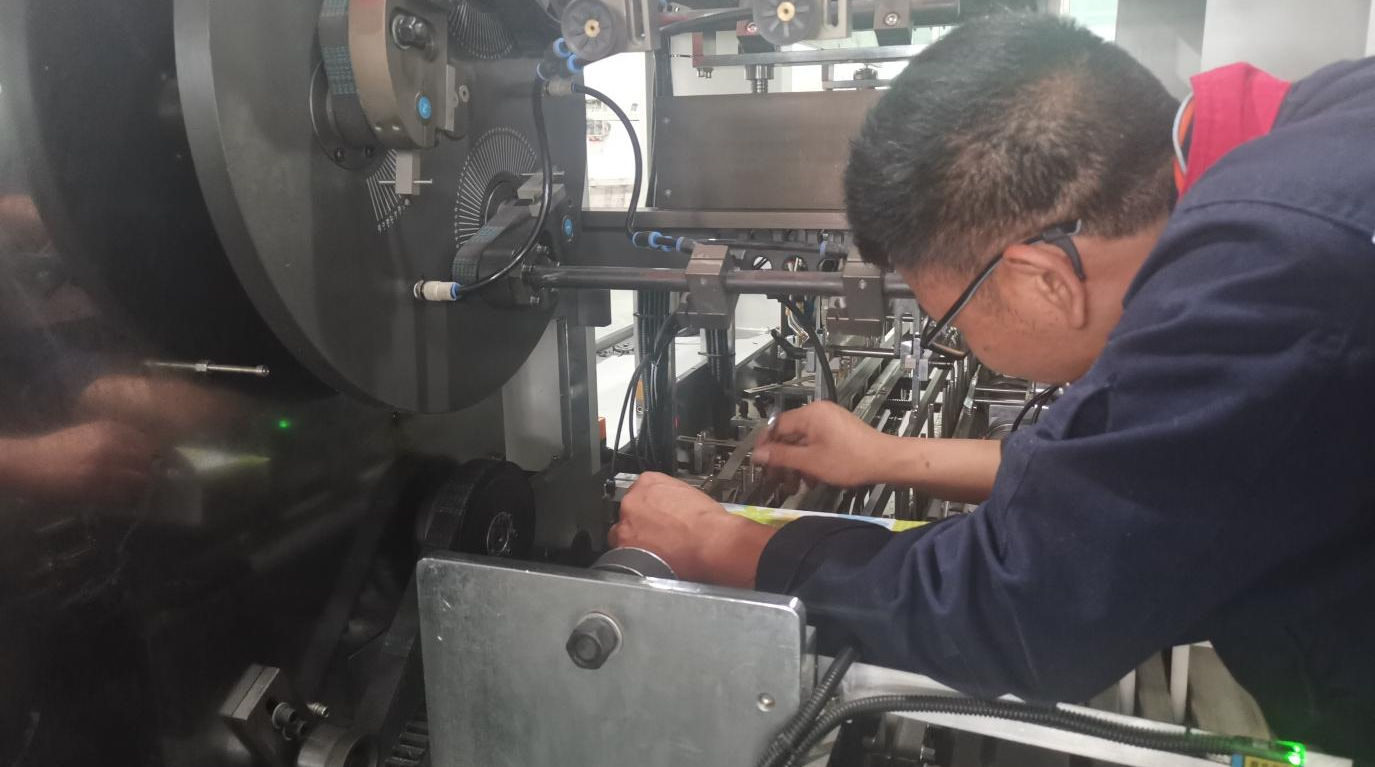
Caption: QA/QC inspectors performing precision measurements on cartoning machine components at Shengtai's facility
Introduction
One of the first decisions packaging buyers face is whether to choose a horizontal cartoning machine or a vertical cartoning machine. Both automate the same basic process—forming, loading, and sealing cartons—but they serve fundamentally different product types and production environments.
Choosing the wrong orientation can result in poor product handling, reduced speed, and frequent changeover headaches. This article provides a technical comparison based on real production data from Wenzhou Shengtai Machinery, which manufactures both horizontal and vertical models for industries ranging from tissue and food to pharmaceuticals and hardware.
How Each Machine Type Works
Horizontal Cartoning Machine
In a horizontal system, the carton is erected and loaded along a horizontal plane. Products are fed into the carton from the side, typically via a pusher mechanism or conveyor belt. This design is ideal for:
- Flat or elongated products (tissue boxes, blister packs, biscuits, soap bars)
- Products that can be stacked or grouped before insertion
- High-speed applications requiring 100–150+ boxes/min
Shengtai's horizontal automatic cartoning machines are the company's core product line, with models that achieve stable speeds of 150 boxes/min for facial tissue packaging.
Vertical Cartoning Machine
A vertical system erects the carton in an upright position and loads products from the top, usually via gravity feed or robotic pick-and-place. This design excels with:
- Loose or granular products (coffee beans, nuts, hardware fasteners, capsules)
- Products that require counting or weighing before loading
- Fragile items that benefit from gentle top-loading
- Moderate speeds of 30–80 boxes/min
Technical Comparison Table
Parameter |
Horizontal Cartoning Machine |
Vertical Cartoning Machine |
Loading direction |
Side-entry (horizontal push) |
Top-entry (gravity or robotic drop) |
Typical speed |
60–130 boxes/min |
20–100 boxes/min |
Product types |
Solid, flat, stackable items |
Loose, granular, counted items |
Carton style |
Tuck-end, glue-seal, tongue-type |
Tuck-end, flap-seal |
Footprint (L×W×H) |
~3,619 × 1,450 × 1,800mm |
~3,515 × 2,494 × 1,767mm |
Changeover complexity |
Moderate (10–20 min) |
Low to moderate (10–15 min) |
Integration |
Easy inline with upstream wrappers |
Often paired with multihead weighers or counters |
Price range (FOB) |
60,000 |
40,000 |
Best industries |
Tissue, food bars, pharma blisters, cosmetics |
Coffee, nuts, hardware, capsules, tea bags |
When to Choose Horizontal
Select a horizontal cartoning machine when:
Your product is rigid and flat
1. : Tissue packs, biscuit trays, blister sheets, and soap bars feed smoothly from the side.
Speed is critical
2. : Horizontal machines handle higher throughput because the product transfer path is shorter and more direct.
You need inline integration
3. : Horizontal machines connect easily with upstream flow wrappers, labelers, and downstream case packers in a straight-line layout.
Your carton uses glue sealing
4. : Horizontal machines accommodate both tuck-end and hot-melt glue sealing options.
Shengtai's horizontal models feature 304 stainless steel construction, 10mm plexiglass safety panels, and Siemens PLC control—standard across all speed tiers.
When to Choose Vertical
Select a vertical cartoning machine when:
Your product is loose or granular
1. : Coffee beans, mixed nuts, screws, and pharmaceutical capsules require top-loading for accurate filling.
You use a multihead weigher or counter
2. : Vertical machines are designed to receive product drops from weighing or counting equipment mounted above.
Floor space is limited
3. : Vertical machines have a smaller footprint and can be positioned in tighter layouts.
Product fragility matters
4. : Gentle top-drop loading reduces impact damage compared to horizontal pushing.
Hybrid Solutions: When Neither Type Is Enough
Some applications require a combination approach. For example:
Sanitary napkin packaging
- : Shengtai offers a dedicated sanitary napkin automatic boxing linkage line that combines horizontal feeding with specialized product orientation and counting modules.
Multi-product kits
- : A custom system may use vertical loading for loose items and horizontal loading for flat items in the same carton.
These hybrid systems typically cost 120,000 FOB and require 4–8 weeks for engineering and build.
Common Mistakes Buyers Make
Choosing based on price alone
1. : A vertical machine is cheaper but cannot handle flat products at high speed. The wrong choice costs more in lost productivity.
Ignoring changeover needs
2. : If you run multiple carton sizes, verify that the machine's adjustment mechanism is tool-free and documented.
Overlooking upstream/downstream compatibility
3. : The cartoning machine must match the speed and product orientation of your existing line.
Not testing with your actual product
4. : Always request a factory acceptance test (FAT) using your real product and cartons before shipment.
Conclusion & Next Step
The choice between horizontal and vertical cartoning machines depends on your product shape, speed requirements, and line layout. Horizontal machines dominate in tissue, food bar, and blister packaging; vertical machines excel with loose, granular, or counted products.
Unsure which type fits your production line? Send us your product samples and carton specs—we'll run a free test and recommend the right model → Shengtai offers product testing at our Wenzhou facility before you commit.
Article 3 of 10 · Word count: ~1,080 · Generated by AccioWork B2B SEO Matrix