
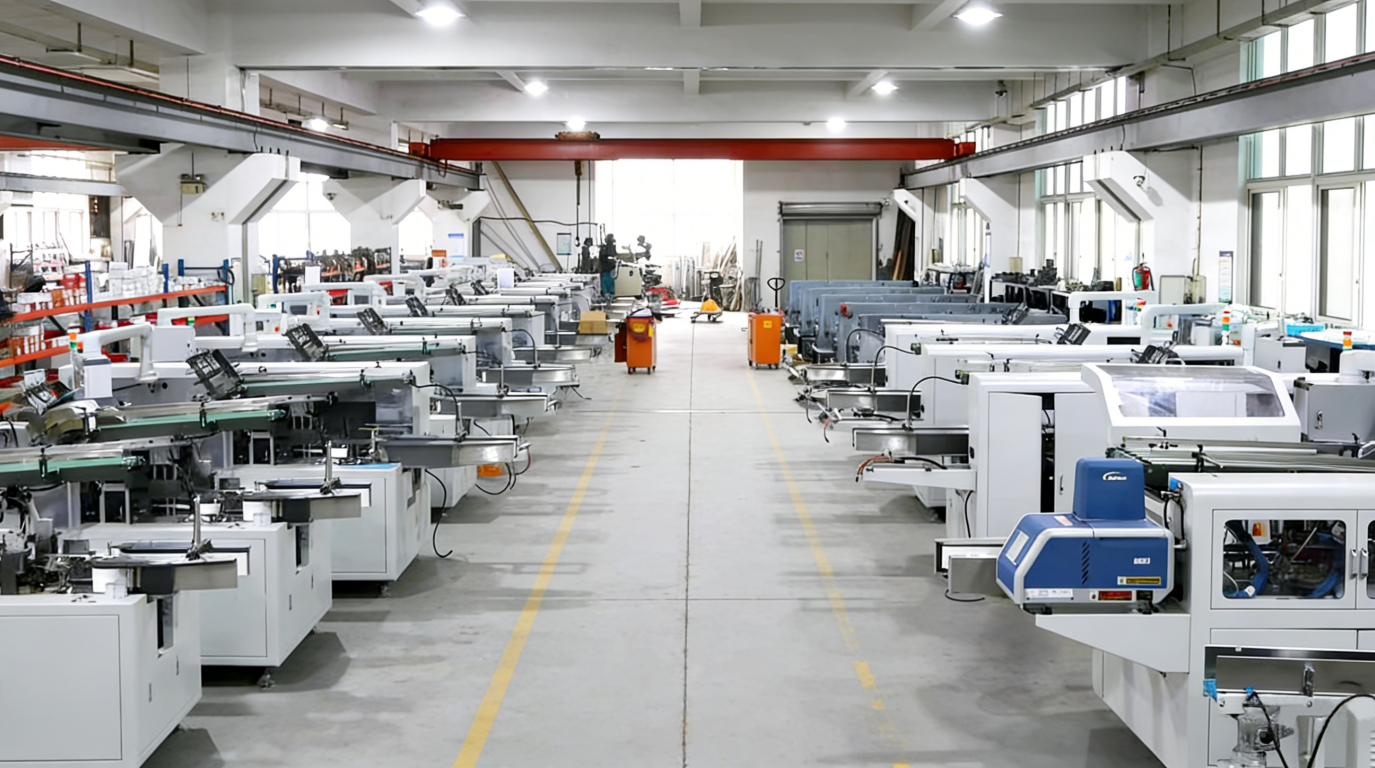
Caption: Automated cartoning machine production line at Wenzhou Shengtai Machinery's 3,400m² facility
Introduction
If you source packaging equipment for tissue products—facial tissue, toilet rolls, kitchen towels, or sanitary napkins—you already know that manual boxing is a bottleneck. A single automatic cartoning machine can replace 6–10 operators and run at 80–150 boxes per minute. But choosing the wrong model leads to frequent jams, inconsistent sealing, and costly downtime.
This guide walks you through the key parameters that matter when selecting an automatic cartoning machine for tissue packaging in 2026. We draw on 10+ years of manufacturing experience at Wenzhou Shengtai Machinery, a supplier that has shipped cartoning equipment to over 20 countries across Europe, Southeast Asia, and the Middle East.
Key Specifications That Define Machine Performance
Not all cartoning machines are built equal. The following parameters determine whether a machine will run smoothly on your production floor:
Speed range
- : Entry-level models run 40–60 boxes/min; mid-range machines achieve 60–130 boxes/min; high-speed units reach 130-200 boxes/min with stable performance.
Carton size range
- : Verify that the machine handles your smallest and largest carton dimensions. Standard range: 100–240mm (L) × 100–120mm (W) × 30–90mm (H).
Changeover time
- : A well-designed machine should switch carton sizes in 10–20 minutes without special tools.
Power consumption
- : Typical range is 3–7 kW depending on speed and configuration.
Air pressure requirement
- : 0.5–0.8 MPa with air consumption of 120–160 L/min for pneumatic models.
Control system
- : PLC with touch-screen HMI (Siemens, Mitsubishi, or equivalent) for easy troubleshooting.
Wenzhou Shengtai's automatic facial tissue cartoning machine achieves a stable 200 boxes/min with servo-driven motion, making it suitable for high-volume tissue converters.
Factory Capability: What to Look for in a Supplier
Your tissue packaging machine supplier's manufacturing capability directly affects machine reliability and after-sales support. Here is what a serious factory should demonstrate:
Production Infrastructure
A credible manufacturer operates a facility of at least 3,000m² with dedicated assembly lines, CNC machining centers, and testing stations. Shengtai Machinery runs a 3,369m² plant in Wenzhou—China's recognized "Packaging Machinery City"—with 29 employees including 4 QA/QC inspectors and 3 R&D engineers.
Component Sourcing
The quality of electronic components determines machine uptime. Reputable builders source PLCs from Siemens or Mitsubishi, sensors from SICK or Omron, and servo motors from Yaskawa or Panasonic. Shengtai uses branded components across all models and maintains a supply chain network of 40 verified partners.
Quality Control Process
Look for factories that perform 100% visual and functional inspection on finished machines. This includes a minimum 48-hour continuous run test before shipment, dimensional verification of all mechanical parts, and electrical safety testing per CE standards.
Speed vs. Cost: A Comparison Table for Tissue Converters
Machine Type |
Speed (boxes/min) |
Approx. FOB Price (USD) |
Best For |
Changeover Time |
Semi-automatic |
40–60 |
10,000 |
Small workshops, startups |
Manual, 30+ min |
Standard automatic |
60–130 |
30,000 |
Mid-volume tissue converters |
15–25 min |
High-speed servo |
130–200 |
60,000 |
Large-scale production |
10–20 min |
Custom linkage line |
150+ |
120,000 |
Fully automated plants |
Automated |
The table above shows that the jump from standard to high-speed roughly doubles the investment but can triple throughput. For tissue converters running 2+ shifts daily, the ROI on a high-speed automatic cartoning machine typically falls within 8–14 months based on labor savings alone.
Compliance and Risk Mitigation
Importing packaging machinery involves regulatory compliance. Ensure your supplier holds:
CE marking
- for machinery sold in the EU (Directive 2006/42/EC)
ISO 9001
- quality management system certification
Patent certificates
- for proprietary mechanisms (Shengtai holds multiple invention patents)
Additionally, request a factory audit report or arrange a third-party inspection (SGS, Bureau Veritas, or TÜV) before final payment. This verifies that the factory's stated capabilities match reality and that the machine meets your specifications.
Conclusion & Next Step
Choosing the right cartoning machine comes down to three factors: matching speed to your production volume, verifying supplier capability through audits and component specs, and ensuring compliance with your market's regulations. A well-selected machine pays for itself within a year through labor reduction and output gains.
Looking for a verified cartoning machine supplier with proven OEM capability? Get a free factory audit report & FOB quote within 24 hours → Or request our latest catalog with full spec sheets for all tissue packaging models.
Article 1 of 10 · Word count: ~1,020 · Generated by AccioWork B2B SEO Matrix